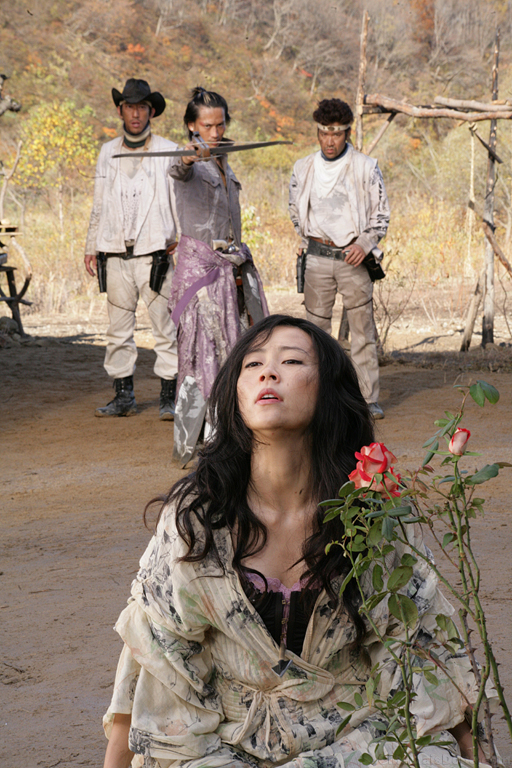
New Cinema Wallpaper of the Day
Monday, August 25, 2008
Full production notes and cast and crew info follow…
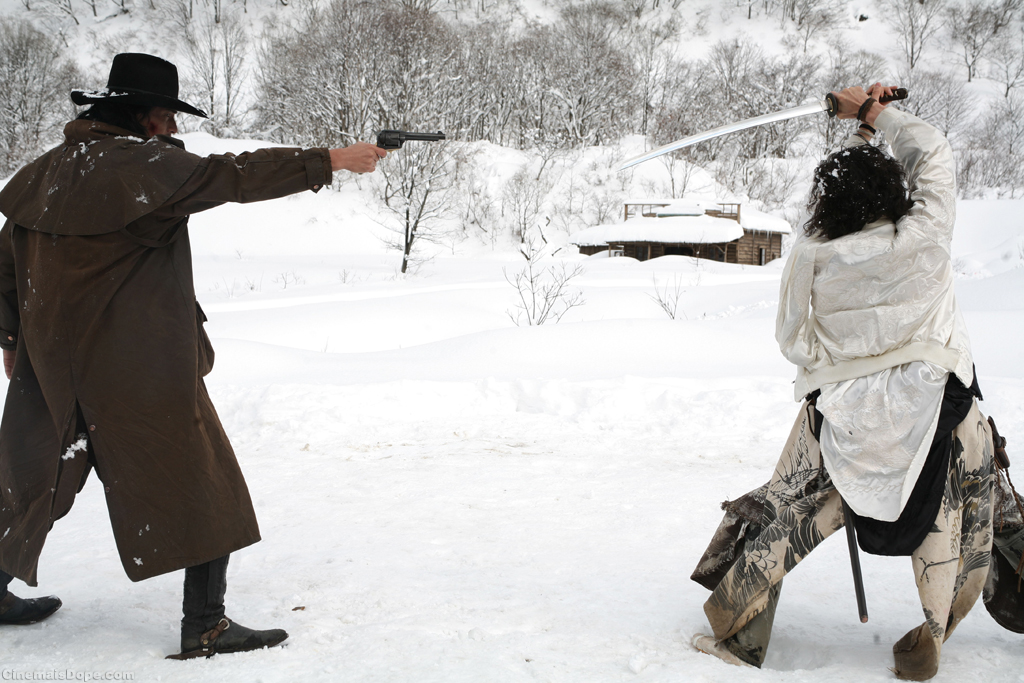
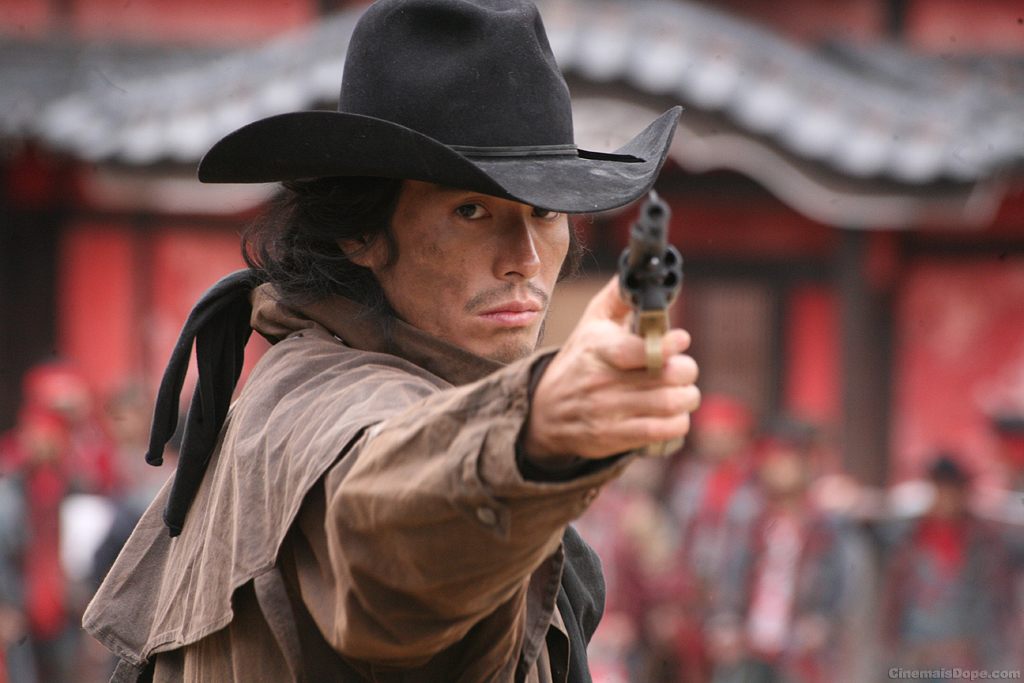
Over at Ryuganji (view here), Don has a great post on the upcoming US release of Miike’s Sukiyaki Western Django along with commentary on its strange US poster and the interview from its production notes. The US poster works fine as a character poster for Yusuke Iseya who plays the leader of the white clad Genji gang, Yoshitsune Minamoto. As an overall poster for the film itself it certainly falls short of what it could have been. This US release seems like it will be a blink and it’s gone type affair so be sure to check and double check your local listings, especially if you live in New York and LA where it kicks off its US run.
Related Coverage:
::: Midnight Madness SUKIYAKI WESTERN DJANGO Intro with Special Message From Miike
::: Review by Todd - Twitch
Japanese Cinema:
::: Jason Gray
::: Mark Schilling’s Tokyo Ramen
::: Midnight Eye
::: Nippon Cinema
::: Outcast Cinema
::: Ryuganji
::: Toronto J-Film Pow-Wow
SUKIYAKI WESTERN DJANGO - PRODUCTION NOTES:
An integration of the Western and the Japanese Tales of Heike…It can be said that Westerns are the roots of Hollywood films while samurai dramas are the roots of Japanese films. That Akira Kurosawa’s Seven Samurai inspired John Sturges’ The Magnificent Seven, one of the all-time great Hollywood westerns, is well known. It is also widely known that Kurosawa’s The Bodyguard became the basis for director Sergio Leone’s Italian film Per un pugno di dollari (Fistful of Dollars). The Made-in-Italy-westerns, dubbed “macaroni westerns” in Japan, and “spaghetti westerns” in the U.S, became a worldwide phenomenon from 1960’s to early 70’s.
The man infusing fresh blood into the genre today is Takashi Miike. While paying the homage to spaghetti westerns, Miike has created a unique and stylish action film in this never-before-seen “sukiyaki” world.
Gun smoke drifts in the air and the haunting sound of melodic whistling echoes as you step into a world that transcends time and space, a world where the Japanese shukuba-machi (post station) and western saloons co-exist. From the familiar scenes of spaghetti westerns, to elements from Tales of The Heike, the War of the Roses and the legendary goddess of murder “The Bloody Benten,” anything goes in the Miike world. The climactic scene even extends a nod to the world of the classic western film, Shane (1953). However, this film is by no means a parody. What emerges from the sukiyaki pot, in which all of these ingredients simmer together, is Miike’s magnificent view of the world.
Music…
The word “spaghetti western” immediately brings to mind the melodies of Ennio Morricone. In Sukiyaki Western Django, Koji Endo has created a melancholic score that combines trumpets, ocarinas and whistling. The original theme song for Django (1966), one of the best spaghetti westerns ever made, has been arranged into a new theme tune for Miike’s film. With newly written Japanese lyrics, a haunting new version is sung by Saburo Kitajima, the veteran enka (Japanese blues) singer, known for his powerful kobushi (a vibrato-like vocal technique).
What’s the connection between the renowned blues singer and Miike? In 1996, Miike directed a made-for-video movie Jingi naki Yabou at the Toei Uzumasa Studio. Saburo Kitajima, who was already major star, had been cast as the gambler. For the film, Miike had unsparingly splashed the great singer/actor with artificial blood. Kitajima had mumbled, “I’ve been acting for some twenty, thirty years and I never knew that artificial blood felt so cold!” Miike’s unconventional techniques left a strong impression on the blood soaked Kitajima.
Behind the Scenes…
A red and white rose blooming in the wilderness. Inside the sukiyaki pot live love and death.
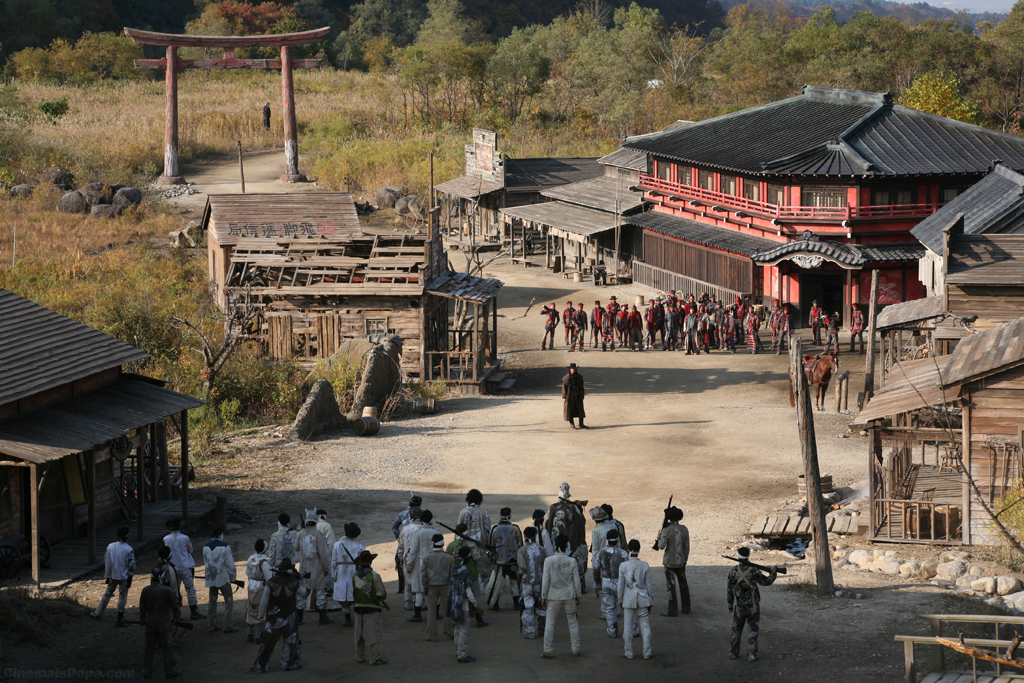
Sukiyaki Western Django was filmed on a specially built outdoor set in Ishikura, Yamagata, deep in the mountains of Tsukiyama. A surreal set combining both a western theme and “Jidai-geki” (Japanese period dramas) suddenly emerged in the midst of Tsukiyama’s magnificent mountain scenery.
The logistical difficulties of the shoot made the production a constant struggle primarily due to the extreme weather conditions. The freezing Fall nights of Tsukiyama were severe enough to freeze the food on the plates of the cast and crew. To make matters worse, it rained for a whole month, turning the ground into mud and when the production needed snow, however, an unusually warm winter resulted in almost no snowfall.
For the scene shot at sunrise in the caves of Zao, the crew had to hit the trail on foot at 2 a.m. in the morning in order to arrive at the location by 4 p.m., allowing enough time to make up the actors. Walking in the darkness with only the lights of the lighting department to rely on, more than a few crew members were nearly lost in the mountains.
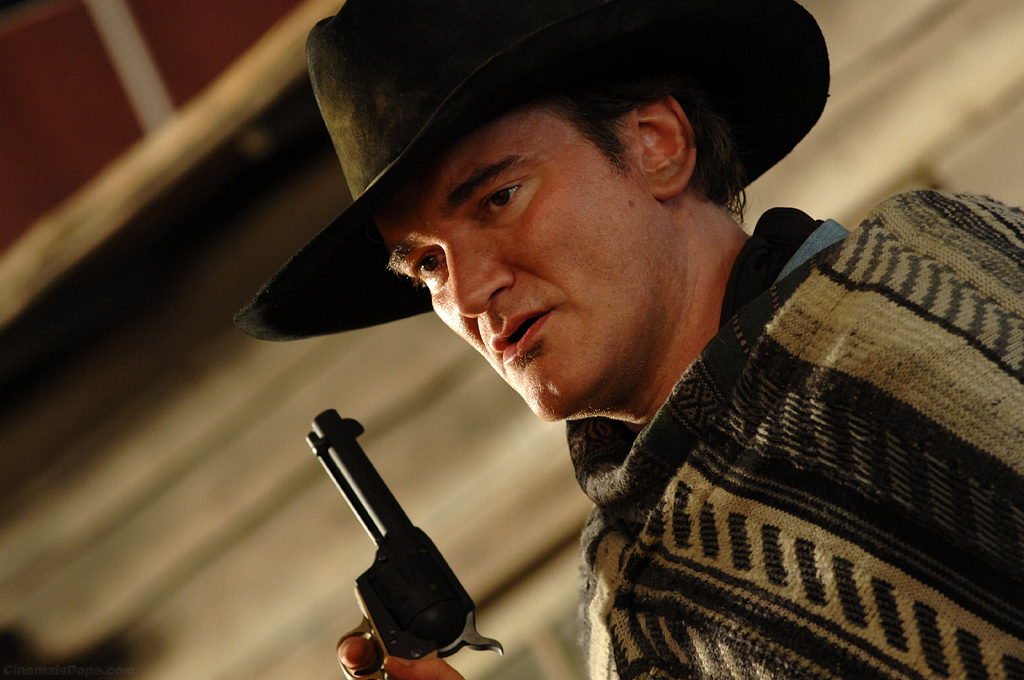
For one shot, forty horses, brought to the set from the Tohoku area, were required to gallop away at full speed, a stunt rarely seen in recent Japanese productions. Working with such a large number of extras and coordinating the complex gunfights was also challenge. As a result, Miike found the usual calls of “Ready!” and “Action!” were not adequate and he resorted to donning a ten-gallon hat, taking out a Smith & Wesson and firing a blank in the air instead! The unexpected sound of gunshot surprised the extras whose reactions were expertly captured on film by cinematographer Toyomichi Kurita. One could say that the ultimate thrill of the production was the “face-off in the wilderness of Shonai territory” between Miike, shooting his Smith & Wesson, and Kurita, shooting with his Arriflex ST<!
Sukiyaki Western Django was shot entirely in English. As with his other English language film, “Masters of Horror – Imprint,” Miike created a unique atmosphere on set. The actors went through a month-long intensive language training under Nadia Venesse, the dialogue coach who has worked with many of the top Hollywood stars in features such as Chocolat and North Country, and with Christian Storms, who translated the Japanese script into English. For Venesse and Storms, Sukiyaki Western Django was their second collaboration with Miike following “Masters of Horror – Imprint.”
Japanese star Koichi Sato’s comment on the experience was: “I realize now how effortlessly I’ve been making money all these years.” The actors not only had lessons in English but were required to learn horseback riding and gun slinging. The actress Kaori Momoi also had the additional challenge of working with flying wires and trampolines as the legendary fighter “Bloody Benten.” At one point her whole body was wrapped in plastic to protect her from the cold, which made even a simple somersault a challenging feat.
Cast & Crew Notes follow…